Dr. Ievgeniia Kopytsia, MSCA4Ukraine
March 2, 2025
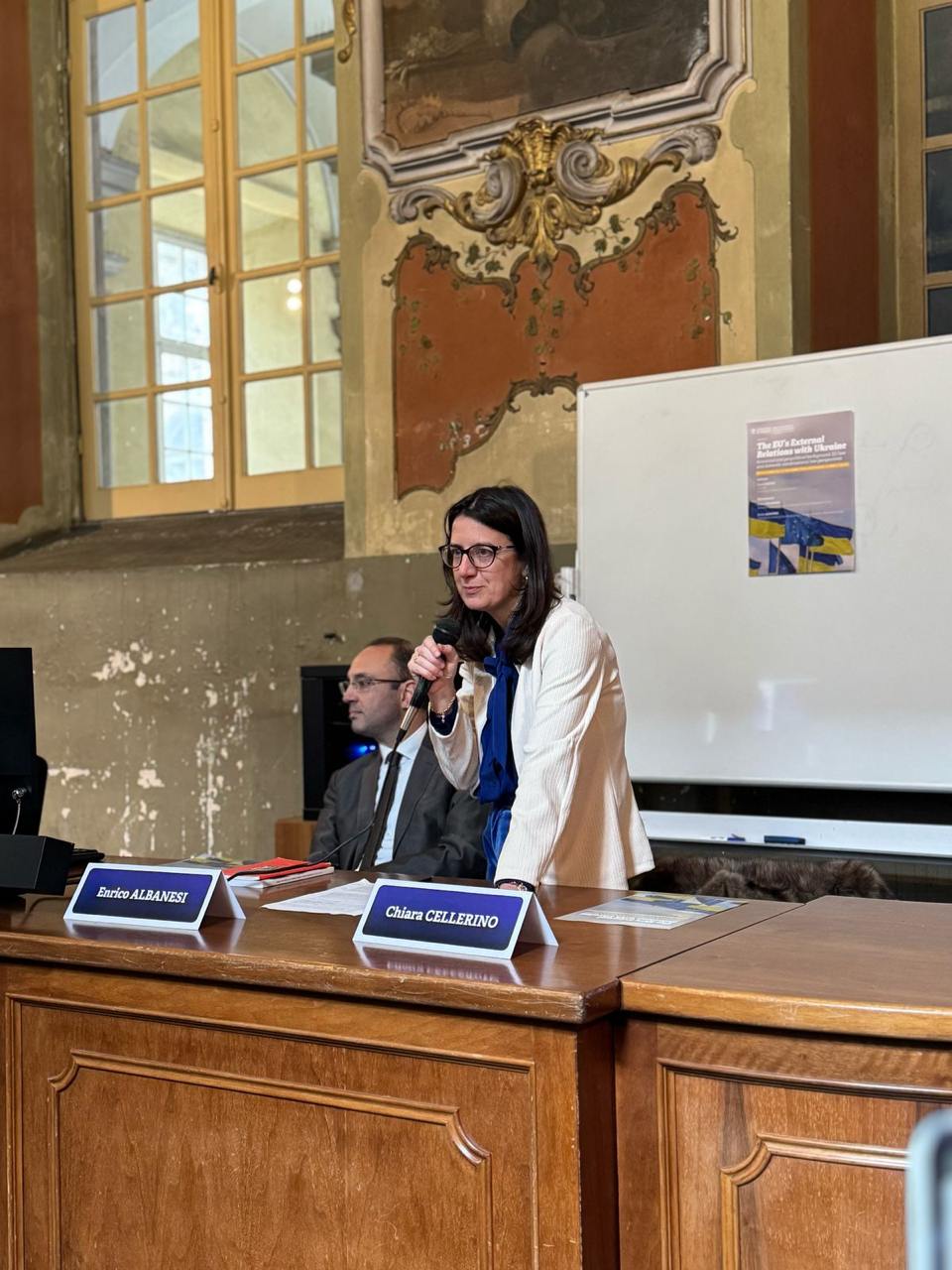
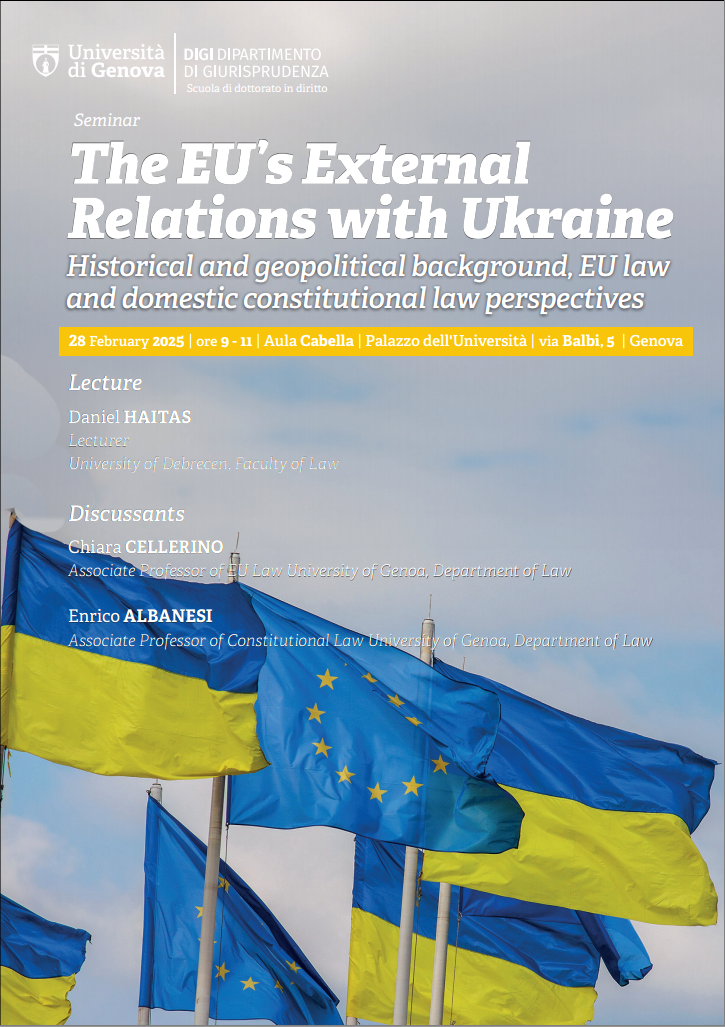
This reflection examines key theoretical and practical insights from the doctoral seminar “The EU’s External Relations with Ukraine: Historical and geopolitical background, EU law and domestic constitutional law perspectives” held at the University of Genoa’s Law Department on February 28, 2025. The seminar provided a valuable opportunity to analyze the evolving legal frameworks governing EU-Ukraine relations within the broader context of European integration processes and legal adaptation in crisis contexts.
Theoretical Frameworks and Methodological Approaches
The seminar, structured around a lecture by Daniel Haitas (University of Debrecen) with critical responses from Professors Chiara Cellerino and Enrico Albanesi (University of Genoa), employed multiple analytical frameworks to examine EU-Ukraine relations. Haitas’s methodological approach combined historical institutionalism with legal formalism, tracing the evolution of legal instruments from the Partnership and Cooperation Agreement through the European Neighbourhood Policy to the Association Agreement and more recent developments.
These observations align with scholarly discourse on legal system adaptability during crisis situations (Zumbansen, 2021; Krisch, 2020) and demonstrate how external pressures can catalyze legal innovation while potentially challenging systemic coherence.
Particularly noteworthy was Haitas’s application of legal resilience theory to analyze how the Association Agreement’s implementation mechanisms have adapted to function under conditions far removed from those envisioned at its inception. This theoretical framework, which examines legal systems’ capacity to maintain functionality despite external pressures, offers valuable parallels to my current research on resilient climate law frameworks during compound crises.
Constitutional Perspectives on Integration Processes
Professor Albanesi’s constitutional law analysis provided essential insights into the reciprocal transformations occurring within both Ukrainian and EU constitutional frameworks.
His examination of constitutional adaptation processes highlighted:
This constitutional perspective complements recent scholarship on legal transplants and constitutional adaptation (Sadurski, 2022; Popelier, 2023) while offering specific insights into Ukraine’s unique constitutional development trajectory.
Professor Cellerino’s contribution introduced a critical analysis of how established EU external relations instruments have been reconfigured in response to Ukraine’s situation. Her examination revealed several important findings regarding legal adaptation mechanisms:
When Legal Theory Meets Reality: Reflections from the Seminar Room
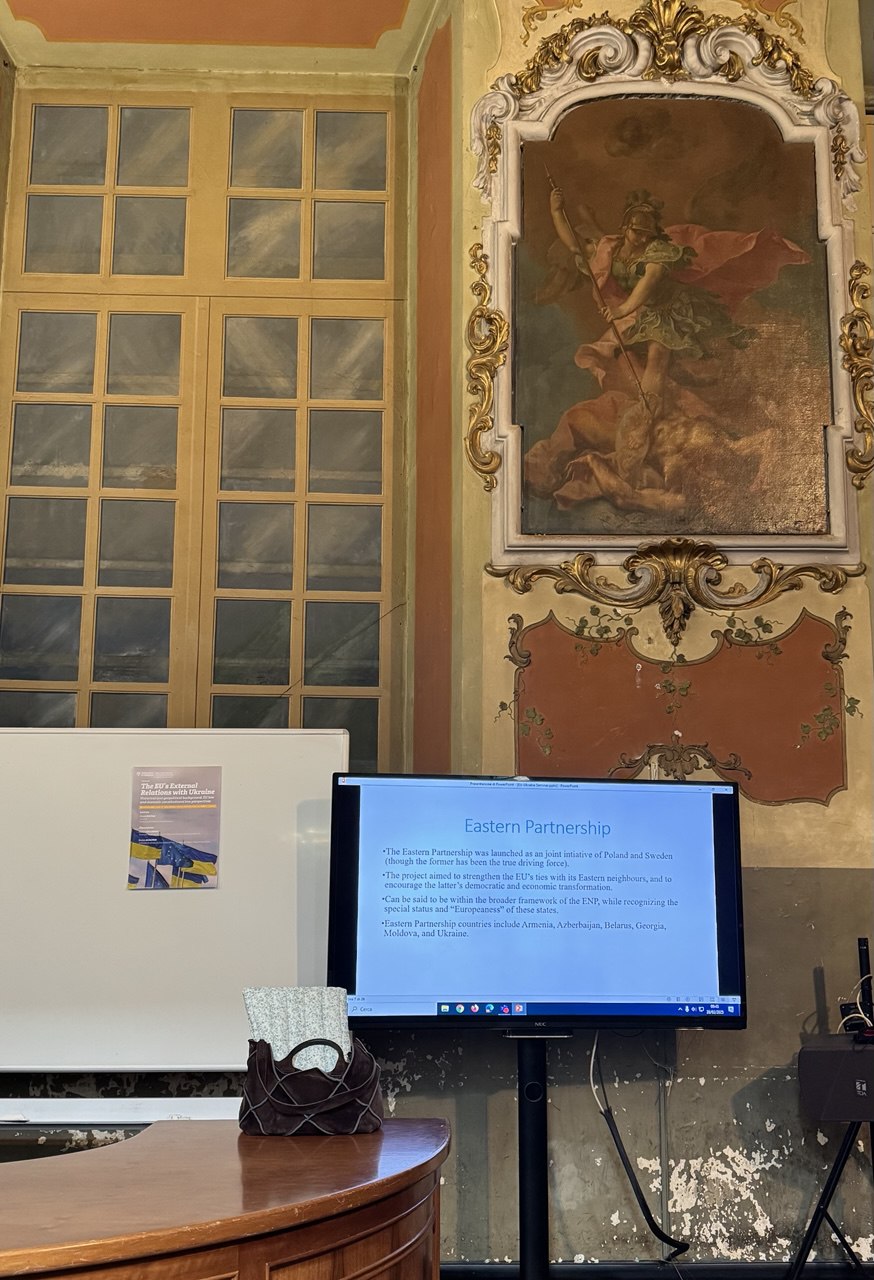
As I sat in the historic Aula Cabella, surrounded by students and fellow researchers, I couldn’t help but think about the stark contrast between our theoretical discussions and the reality facing Ukraine. The wood-paneled walls and centuries-old architecture of Palazzo dell’Università seemed far removed from the challenges people of Ukraine are facing in their every day life.
The thought I had: “It’s remarkable to be discussing EU legal frameworks while Zelensky is meeting with Trump right now. These aren’t just abstract legal concepts we’re debating—they have real implications for millions of people.”
Professor Haitas captured this sentiment beautifully during his presentation: “Legal frameworks are living instruments. They exist on paper, yes, but they come alive through implementation, interpretation, and adaptation.” He showed a slide depicting the evolution of EU-Ukraine legal relations through a timeline of formal agreements, but then added: “Behind each of these documents are countless human stories—of judges interpreting provisions, officials implementing regulations, and citizens navigating changing legal landscapes.”
This human dimension of legal frameworks is something I’ve witnessed firsthand in my research. While we can analyze the technical resilience of climate governance systems through academic frameworks, the true test comes when these systems face real-world pressures—when they must protect ecosystems and communities during conflicts, energy crises, or economic hardships.
I kept on asking myself – what are the practical mechanisms for maintaining environmental protections during the current “challenging period”. In Ukraine we call it full-scale war. The world calls it differently: perfect storm, systemic risk, all types of crises: polycrises, permacrisis and even metacrises.
Yes, we have to acknowledge the limitations of traditional legal analysis in addressing such urgent concerns, noting that sometimes our legal frameworks need to catch up with reality. All the challenges Ukraine faces require both immediate solutions and long-term legal structures.
This exchange perfectly captured what I explore in my research on resilient climate law frameworks—the tension between immediate response mechanisms and enduring legal architectures. It’s not enough to have well-designed climate laws on paper; these frameworks must function effectively even when faced with extraordinary pressures.
Climate Law Reflections: Legal Resilience in Multidimensional Crises
As an environmental legal scholar, I was particularly struck by the parallels between the adaptation mechanisms discussed in relation to EU-Ukraine legal relations and those emerging in environmental governance systems facing compound crises. The seminar discussions revealed important structural similarities between these ostensibly distinct domains:
The concept of “adaptive legal capacity” (Ebbesson & Hey, 2013) emerged repeatedly throughout the seminar, albeit using different terminology. Just as environmental governance systems have developed reflexive mechanisms to respond to changing ecological conditions, the EU-Ukraine legal relationship demonstrates an evolving adaptive capacity in response to geopolitical disruption. This adaptive process is evident in the expedited implementation of certain Association Agreement provisions and the development of novel legal instruments addressing Ukraine’s unique circumstances.
What environmental law scholars term “nested governance structures” (Ostrom, 1990) finds parallel expression in the multilevel legal frameworks governing EU-Ukraine relations. The interaction between international agreements, EU directives, and domestic implementation mechanisms creates complex governance architectures that both enable and constrain adaptation pathways. These nested structures can provide redundancy and flexibility during crises, but can also generate coordination challenges and implementation gaps—a phenomenon equally observed in transnational environmental governance regimes.
Most significantly, the seminar highlighted how legal systems facing existential threats must balance immediate crisis response with long-term structural integrity—a central concern in my research on climate law resilience. This tension manifests in environmental governance through the dual imperatives of addressing immediate climate impacts while constructing sustainable regulatory frameworks. Similarly, EU-Ukraine legal relations demonstrate the challenge of responding to immediate humanitarian and security concerns while maintaining consistent integration processes.
Conclusion
The UNIGE seminar on EU-Ukraine relations offered substantive theoretical frameworks and comparative insights that enhance understanding of legal resilience during periods of systemic stress. Beyond specific content knowledge, this academic exchange exemplifies the intellectual cross-fertilization that the MSCA4Ukraine fellowship program aims to facilitate—creating scholarly networks that connect Ukrainian and European academic institutions during challenging circumstances.
From an environmental and climate law perspective, the seminar underscored how legal systems across domains develop parallel adaptation mechanisms when confronting existential threats. These structural similarities suggest possibilities for cross-domain knowledge transfer—applying insights from environmental and climate governance to broader legal resilience questions, and vice versa. This interdisciplinary approach forms the core methodological foundation of my research project on resilient climate law frameworks.
As the ResClimLaw project ( www.sustainlaw.com/resclimlaw) proceeds, I will incorporate these theoretical insights into both the analytical framework development and practical case studies examining environmental governance during conflict and post-conflict reconstruction.
P.S. While Scholars Discussed: The Washington Meeting That Shocked the World
The seminar coincided with President Volodymyr Zelensky’s diplomatic visit to Washington D.C., where he met with President Donald Trump in the Oval Office. The shock that reverberated across the world following the unprecedented heated exchange during the meeting. In a stunning breach of diplomatic protocol, President Trump and Vice President Vance berated President Zelensky for perceived ingratitude, with Trump claiming Ukraine would have disappeared “in about two weeks” without U.S. assistance and warning that Ukraine was “gambling with World War III.” The meeting ended with Zelensky departing the White House ahead of schedule, while Trump later posted that the Ukrainian president “can come back when he is ready for Peace.”
The juxtaposition of this diplomatic rupture in Washington with scholarly discussions in Genoa highlighted not just the multi-dimensional nature of Ukraine’s international engagement, but also the extreme volatility of the geopolitical environment within which legal frameworks must function. Today academic discourse must not and does not exist not in isolation, but rather in dynamic relationship with ongoing geopolitical developments, lending any theoretical discussions immediate and urgent practical relevance.
As Professor Cellerino noted during our discussions, the evolution of EU-Ukraine legal relations cannot be understood in isolation from broader international alignments, including the critical U.S.-Ukraine relationship being simultaneously reaffirmed at the highest diplomatic level.
References
Ebbesson, J., & Hey, E. (2013). Introduction: Where in law is social-ecological resilience? Ecology and Society, 18(3), 25.
Krisch, N. (2020). Liquid authority in global governance. International Theory, 12(3), 395-425.
Ostrom, E. (2010). Polycentric systems for coping with collective action and global environmental change. Global Environmental Change, 20(4), 550-557.
Popelier, P. (2023). Constitutional identity and European integration: The view from national constitutional courts. European Constitutional Law Review, 19(1), 45-71.
Sadurski, Wojciech. (2020). Constitutional democracy in the time of elected authoritarians. International Journal of Constitutional Law 18, no. 2: 324-333.
Tooze, A., & Watkins, E. (2023). Explaining Polycrisis and Metacrisis. *Reality Studies*. https://www.realitystudies.co/p/explaining-polycrisis-and-metacrisis
Zumbansen, P. (2010). The Conundrum of Order: The Concept of Governance from an Interdisciplinary Perspective. In D. Levi-Faur (Ed.), The Oxford Handbook of Governance. Oxford University Press. Osgoode CLPE Research Paper No. 37/2010.