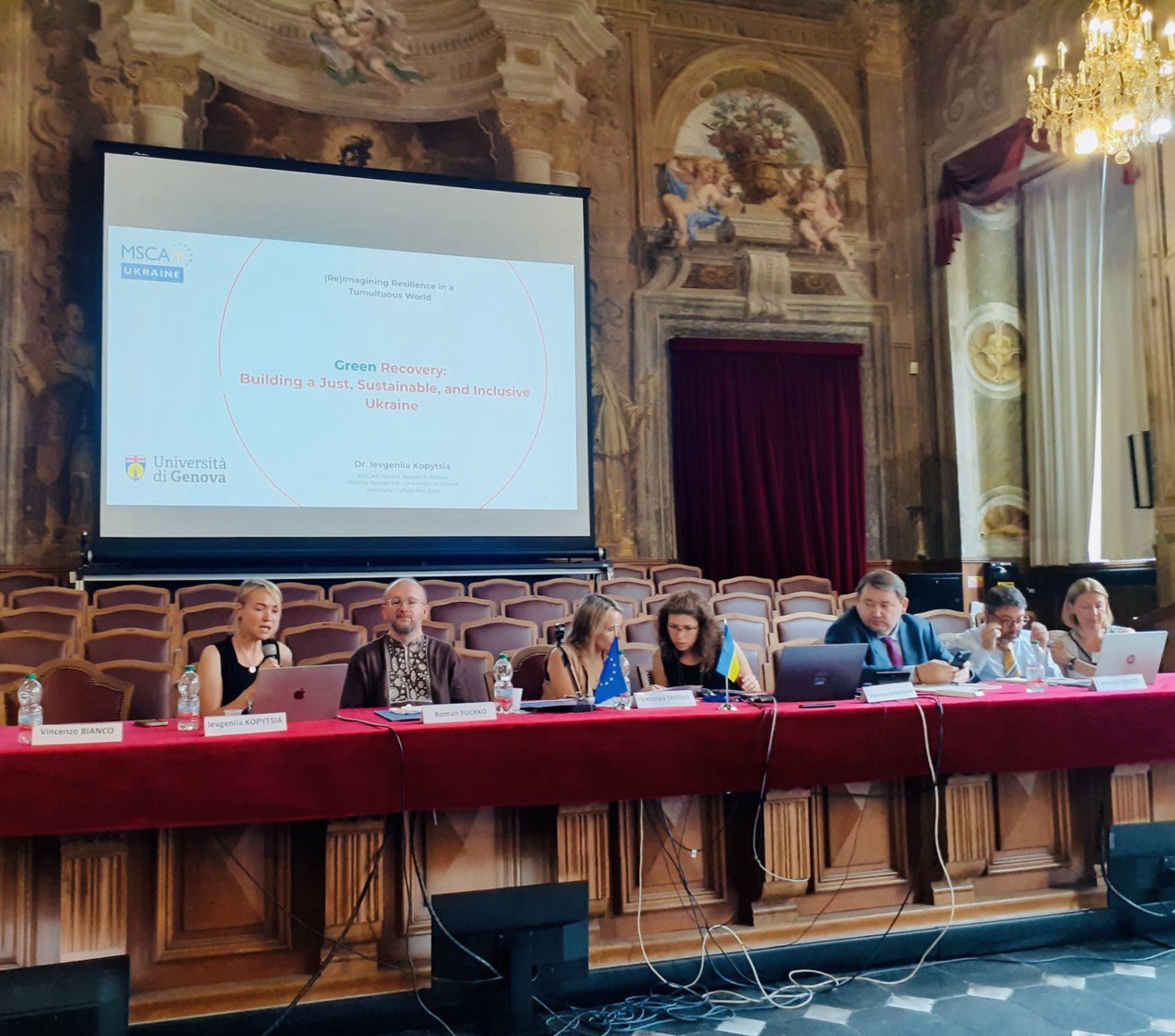
By Dr. Ievgeniia Kopytsia
MSCA4Ukraine Fellow
On July 14, 2025, just days after the Ukraine Recovery Conference (URC2025) in Rome, the University of Genoa hosted a high-level academic forum: “Constitutional and Institutional Challenges for Ukraine’s Post-War Reconstruction on the Path to the EU.” The event brought together leading legal, economic, and policy experts to confront both the immense devastation wrought by Russia’s invasion and the transformative opportunities that now lie before Ukraine.
Drawing on the latest research and official statistics, this report distills the key findings and reflections from the conference, illuminating both Ukraine’s current ordeal and the critical crossroads shaping its future.
The Magnitude of Destruction
Since Russia’s full-scale invasion in 2022, Ukraine has faced destruction on a continental scale. By mid-2025, the length of the active frontline is 1,500 kilometers—exceeding the distance from Santiago de Compostela to Warsaw, or Athens to Bern. This relentless frontline not only represents a military boundary but bisects communities, agriculture, ecosystems, and daily life.
The pace of territorial loss has recently surged. Data from DeepState mapping confirms that just in the first five months of 2025, Russian forces captured 1,280 km²—more than twice the territory taken during the same period of the prior year. In human terms, this is an area equivalent to five times the size of Genoa or comparable to Rome, underscoring the immense, ongoing dislocation and trauma faced by millions.
Civilians bear the brunt of conflict. From January 2024 through June 2025, over 3,184 civilians have been confirmed killed and nearly 14,800 wounded by official counts, though the true toll is higher, particularly near active frontlines. Every month, new atrocities emerge. June 2025 alone marked the highest monthly death toll since the full invasion began. Many cities—once vibrant—are now partly or wholly destroyed. For example, Bakhmut’s devastation is representative of hundreds of Ukrainian towns.
Air raid alerts have become a routine aspect of daily life. Kharkiv residents, for example, endured air raid sirens for three out of the first six months of 2025. Entire oblasts such as Sumy, Donetsk, and Kharkiv, as well as Luhansk and Crimea, have seen persistent air sirens—an unending atmosphere of insecurit
Economic and Environmental Catastrophe
Ukraine’s infrastructure and economy have suffered enormous blows. Over 1,500 major industrial and critical infrastructure sites have been damaged. Official estimates put the direct asset destruction cost at $176.1 billion, with indirect economic losses (including debris removal and lost productivity) rising to $588.8 billion. The World Bank now estimates total recovery needs at approximately $524 billion over the next decade—three times Ukraine’s pre-war GDP and a sum comparable to a quarter of Italy’s national economy.
Energy has been a particular target. By August 2024, 44.7% of Ukraine’s pre-war electricity generation capacity had been destroyed. Nationwide blackouts followed large-scale coordinated strikes, most notably on November 23, 2022, when Ukraine experienced nearly a week without reliable power. The attacks on power plants, substations, and grids not only disrupt basic services but also present cascading risks for water, healthcare, and industry.
Agribusiness, once the backbone of Ukrainian exports and food security, has been battered. Direct losses in 2022–2023 stand at $10.3 billion, with further indirect losses from lost production, degraded soil, and destroyed equipment. Some of the most fertile regions—also among those most affected by fighting—face a long recovery both ecologically and economically.
Environmental consequences are equally dire. Hostilities have caused over 22,800 war-related fires, with damages totaling $18.4 billion. Emissions caused by warfare, post-blast fires, and emergency responses now total an estimated 230 million tonnes of CO₂ equivalent—comparable to the output of over 120 million cars, or four Central European countries combined. Rivers and ecosystems are gravely polluted: the Sukhyi Torets River, for instance, showed manganese and mercury concentrations dozens of times greater than safe standards after de-occupation.
The destruction of the Kakhovka Hydroelectric Dam in June 2023 serves as a stark case study. The dam’s collapse flooded over 2,050 square kilometers, displaced entire communities, and led to catastrophic loss of habitats, including 23 protected natural sites. Toxic substances, from oil spills to industrial waste and even unexploded ordnance, entered the floodplain and Black Sea, igniting a long-term environmental disaster. Weeks after the flood, oil concentrations in Black Sea water samples were more than six times the permissible limit, and groundwater mineralization exceeded health standards.
The risks of technological and nuclear catastrophe also persist. Russian occupation of the Zaporizhzhia Nuclear Power Plant and previous takeover of the Chornobyl site has repeatedly threatened Ukraine and Europe with the possibility of severe radiological release. Only the ongoing work of Ukrainian engineers and international oversight has so far prevented a tragedy.
Recovery Is Resistance
Crucially, recovery is not something to wait for. It is already underway, occurring in real time, amid ongoing attacks, uncertainty, and grief.
The determination of Ukrainians remains unmatched. By April 2025, 75% of displaced citizens surveyed across the EU said they plan to return and help rebuild—a rise from 55% in 2023. This is not only an act of resilience; it is a political statement of hope.
The presentations in Genoa underscored that Ukraine cannot restore its pre-war status quo. Green, just, and people-centered recovery is not optional; it is the only viable foundation for a resilient future, socially, economically, and ecologically.
Green Recovery as Ukraine’s Strategic Compass
In my talk “Green Recovery: Building a Just, Sustainable, and Inclusive Ukraine”, I argued that recovery cannot be approached as a technocratic exercise in repair. It must be transformational. The staggering environmental and social damages from the war demand a strategy that is not merely about rebuilding, but about reimagining a sustainable, resilient, and equitable future.
Crucially, the green recovery is not a luxury, it is an urgent necessity deeply intertwined with the country’s energy security, economic revival, and societal wellbeing. Ukraine’s long-term survival depends on a decisive break from fossil-fueled, extractivist models of growth. From the design of climate-adapted housing and circular economy systems, to decentralised energy and green jobs for frontline communities, Ukraine’s recovery can serve as a living laboratory for sustainable reconstruction.
But how can we achieve this ambitious vision in practice? The Roadmap for the Sustainable Recovery of Ukraine —to which I proudly contributed as an expert author, sets out clear critical priorities and actionable pathways to realize this vision. It calls for rebuilding energy infrastructure with a focus on renewables, reconstructing housing to be resilient and inclusive, restoring ecosystems and natural resources, modernizing agriculture in line with EU standards, and advancing governance reforms that ensure transparency, citizen engagement, and accountability in every aspect of recovery. This comprehensive strategy, rooted in European integration and climate commitments, offers a powerful and practical framework for channeling investments, reforms, and collective efforts toward a truly just and green recovery for Ukraine.
Development Crossroads?
Amid ongoing war, Ukraine may seem, especially for those outside Ukraine’s recovery and policy communities, to stand at a crossroads between devastation and promise of transformation. And indeed, this is the reality. The core challenge is not a lack of understanding that Ukraine must “build forward, not back,” but in fact, the challenge lies in securing long-term investment, strong international commitment, and clear priorities for ecological and social restoration.
What we need is not incremental change but sustained, coordinated international partnership, bold investment in ecological restoration, and policies that put people’s well-being and inclusion at the very center.
Ukraine’s recovery is also an international project. Drawing inspiration from Nordic approaches to polycentric urbanism, Japanese energy efficiency, German models of decentralization, and the evolving body of EU climate law, Ukraine can become a living laboratory for a 21st-century model of green and inclusive resilience.
Crucially, the process of recovery neither does nor can wait for the end of hostilities. Reconstruction is unfolding in real time, in parallel with Ukraine’s ongoing struggle for freedom and security. Roads shattered by bombing are being repaired, schools and hospitals reopened, and communities replant forests and flowers across land devastated by war. In just 2023 and early 2024, over 120 hectares of damaged forests in the Kharkiv region have been restored, turning scars of war into symbols of hope. In Irpin and Bucha, residential housing is being rebuilt with energy-efficient materials, while new schools and community centres are opening their doors to returning families.
Across the country, recovery is not a future phase, it is happening now. And the decisions made now, by Ukraine and by the international community, will shape not only the future of a single nation, but the trajectory of European and global security and sustainability for decades to come.
A Model for Europe and the World
Let’s consider the implications from another angle: Ukraine stands not only at a crossroads, but at the very forefront of global transformation. Insights from the Genoa conference made clear that what is being developed in Ukraine today, through adversity, courage, and exceptional solidarity, will have profound repercussions for Europe’s green transition, the pursuit of global climate justice, and new paradigms for post-conflict recovery worldwide.
As researchers, legal scholars, policymakers, and global citizens, we all bear the responsibility to ensure that Ukraine’s recovery is not short-changed, financially or politically. The costs of reconstruction are indeed monumental. Yet the costs of inaction — ecological collapse, social fragmentation, and the resurgence of authoritarianism—would be far greater, not only for Ukraine but for the world.
 This report reflects discussions and findings from the academic forum “Constitutional and Institutional Challenges for Ukraine’s Post-War Reconstruction on the Path to the EU,” held at the University of Genoa on 14 July 2025. Special
thanks go to Federico Delfino, Gisella De Simone, Vladyslav Rashkovan, Enrico Albanesi, Iurii Barabash, Gerolamo Taccogna, Andrii Zhupanyn, Maksym Nefodov, Anna Babych, Viktoriya Trotska, Vincenzo Bianco, Antonio Comite, Roman Puchko,
Yevgeniya Blyznyuk, and Angelo Musaio for their insights, expertise, and contributions to the discussions that greatly enriched this report.
This report reflects discussions and findings from the academic forum “Constitutional and Institutional Challenges for Ukraine’s Post-War Reconstruction on the Path to the EU,” held at the University of Genoa on 14 July 2025. Special
thanks go to Federico Delfino, Gisella De Simone, Vladyslav Rashkovan, Enrico Albanesi, Iurii Barabash, Gerolamo Taccogna, Andrii Zhupanyn, Maksym Nefodov, Anna Babych, Viktoriya Trotska, Vincenzo Bianco, Antonio Comite, Roman Puchko,
Yevgeniya Blyznyuk, and Angelo Musaio for their insights, expertise, and contributions to the discussions that greatly enriched this report.
 The research was supported by the MSCA4Ukraine project “Towards Resilient and Resistant Climate Change Law” (grant no. 10110192), funded by the European Union.
References
- World Bank. (2024). Ukraine Rapid Damage and Needs Assessment.
- DeepState Map. (2025). Territorial Control and Frontline Data. https://deepstatemap.live/
- Office of the United Nations High Commissioner for Human Rights (OHCHR). (2025). Civilian Casualties in Ukraine.
- Ukrainian Government and Ministry of Energy. (2024). Infrastructure and Energy Sector Damage Reports.
- DiXi Group, Energy Map, NEURC, Ukrenergo, United Nations. (2024). War’s Environmental Impact on Ukrainian Energy.
- Gradus Research. (2025). Survey on Ukrainian Return Intentions.
- Kiel Institute for the World Economy. (2025). Ukraine Support Tracker: Aid Commitments and Deliveries.
- United Nations Environment Programme (UNEP). (2024). War and Environmental Pollution in Ukraine.
- Ecoaction. (2025). Greenhouse Gas Emissions and War-related Impact.
- Kharazishvili, Y., et al. (2023). “Green Recovery in Ukraine: Pathways for Climate-Resilient Reconstruction.” International Journal of Environmental Policy.
- European Council. (2023). Ukraine’s EU Accession: Opportunities and Environmental Policy.
- Truth Hounds & Top Lead. (2024/2025). Environmental Crimes and River Contamination Documentation.
- Chatham House, “Ukraine’s Recovery: International Lessons for Reconstruction.” (2024).