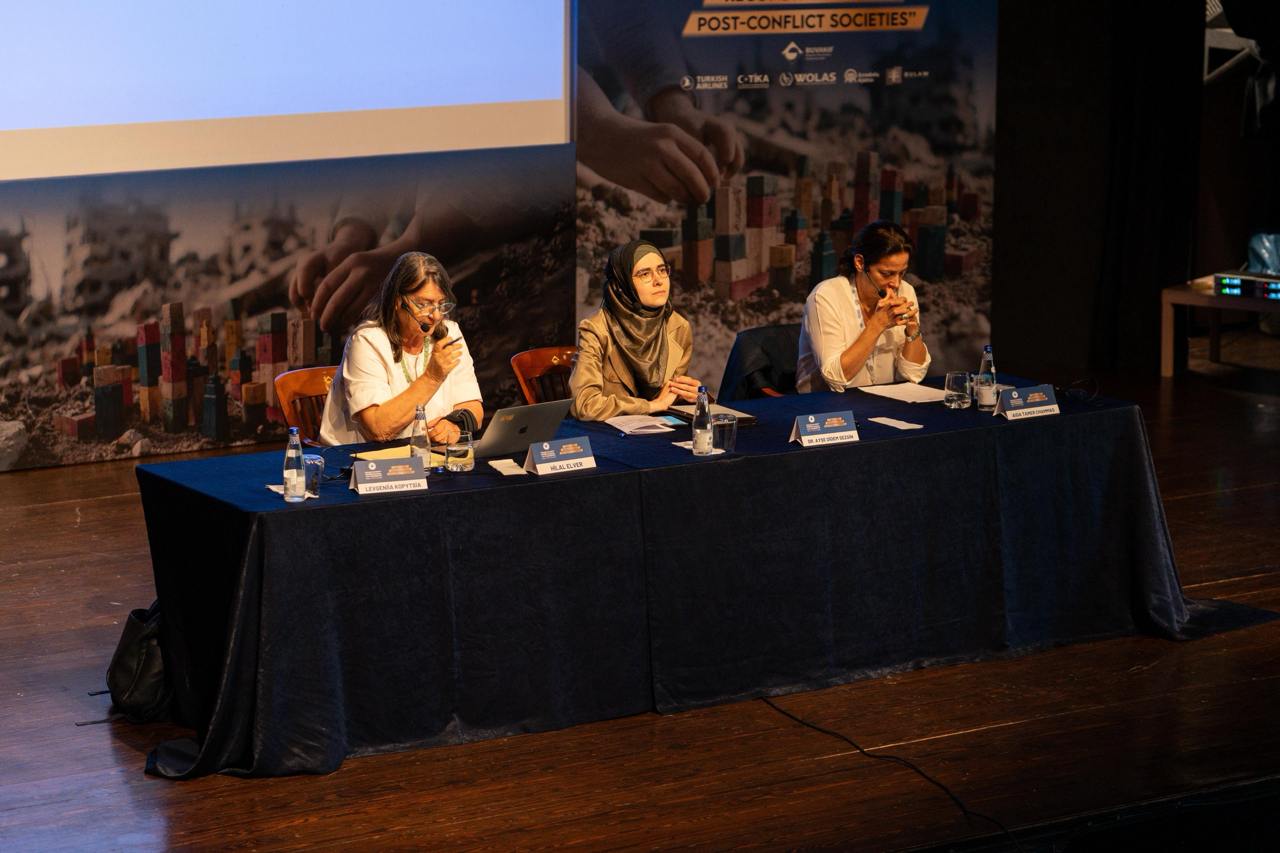
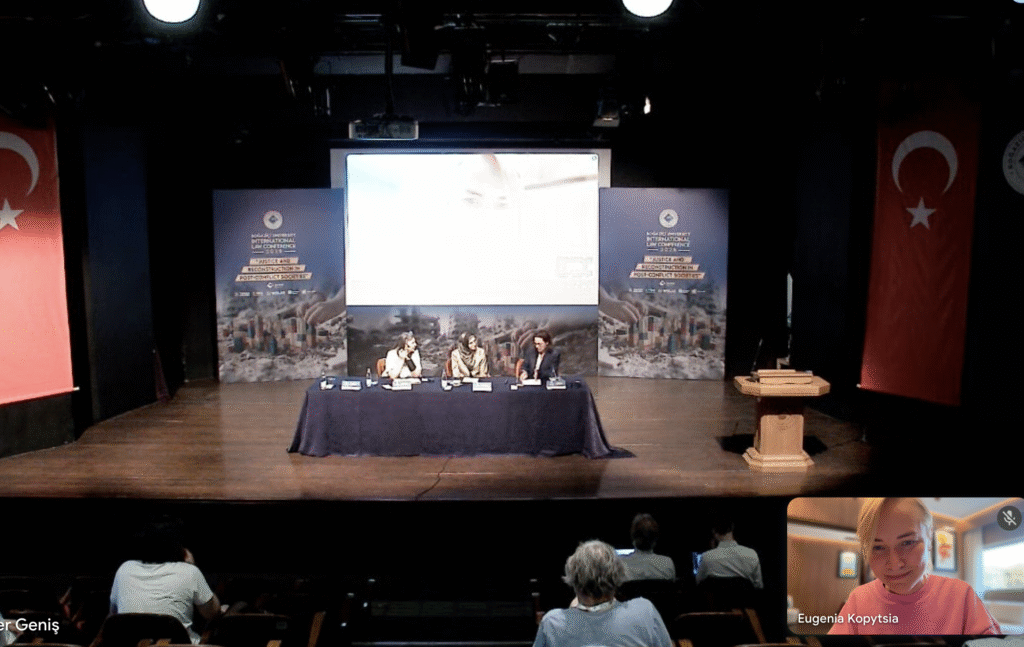
Participating as a panelist at the Boğaziçi University International Law Conference 2025 was both an honor and a profound opportunity to engage with leading scholars and practitioners on the urgent question of justice and reconstruction in post-conflict societies. My presentation, “Towards Resilience, Security and Recovery: Reshaping Post-War Environmental Legal Frameworks,” drew from my recent research on the Russia-Ukraine war’s environmental and climate impacts, situating these findings within the broader context of international law and post-conflict recovery. The panel, featuring Prof. Hilal Elver and Dr. Aida Tamer Chammas, offered a rich, interdisciplinary dialogue on the legal, ecological, and humanitarian dimensions of post-war reconstruction.
The Environmental Toll of Modern Warfare
My presentation examined how the ongoing Russia-Ukraine conflict has served as a stark revelation of the profound inadequacies within our current international legal architecture for environmental protection and climate security. This war represents more than a regional conflict; it has become a case study in how modern warfare can inflict unprecedented environmental devastation that transcends national borders and generational timelines.
The environmental destruction we have witnessed defies the scope of what existing legal frameworks were designed to address. From widespread ecosystem degradation and systematic infrastructure destruction to massive greenhouse gas emissions, the conflict has exposed critical vulnerabilities in the mechanisms we rely upon to address war-induced environmental harm. These gaps are not merely technical oversights but fundamental flaws that leave vast areas of environmental damage legally unaddressed and practically unaccounted for.
The fragmentation of our current legal landscape presents one of the most significant challenges. International humanitarian law, environmental law, and climate agreements exist as separate, often disconnected systems that struggle to respond cohesively to the complex environmental realities of contemporary warfare. This fragmentation means that environmental crimes in conflict settings often fall through jurisdictional cracks, with no single legal framework equipped to address the full scope of harm.
The documented environmental damage from the war in Ukraine provides sobering evidence of these systemic failures. The war has contaminated millions of hectares of agricultural land, threatening food security not just locally but across regions that depend on Ukrainian grain exports. The systematic targeting and destruction of critical energy infrastructure has created environmental hazards that extend far beyond immediate military objectives, affecting water treatment facilities, industrial sites, and residential areas with long-term consequences for public health and environmental stability.
Perhaps most catastrophically, events like the destruction of the Kakhovka Dam have demonstrated how modern warfare can trigger environmental disasters with cascading effects that ripple across ecosystems and national boundaries. The dam’s destruction unleashed flooding that devastated local communities while simultaneously draining water reserves critical for regional agriculture and industrial operations. These cascading effects illustrate how environmental damage in conflict settings creates interconnected crises that existing legal frameworks are ill-equipped to prevent, address, or remedy.
The climate security dimension of this conflict reveals another critical gap in our legal and policy frameworks. The war’s conflict-related emissions, estimated at 175 million tonnes of CO2 equivalent, represent a massive contribution to global greenhouse gas concentrations that remains largely unaccounted for in international climate frameworks. This emission estimate encompasses not only direct military activities but also the carbon costs of reconstruction, displaced populations, and disrupted economic systems.
This climate security gap highlights a fundamental contradiction in how we approach global environmental governance. While the international community has committed to ambitious climate targets through agreements like the Paris Accord, the environmental costs of conflict remain external to these calculations. This means that wars can effectively undermine global climate commitments without any legal accountability or compensatory mechanisms, creating a system where environmental destruction through warfare operates outside the very frameworks designed to protect our planetary climate systems.
The implications extend beyond immediate environmental damage to questions of intergenerational justice and global equity. The environmental toll of modern warfare disproportionately affects vulnerable populations who contributed least to the conflicts but bear the greatest environmental costs. This pattern demands legal innovation that can address not only immediate environmental harm but also the long-term, transboundary effects that characterize contemporary environmental destruction in conflict settings.
Panel Synergy: Connecting Environmental, Humanitarian, and Legal Perspectives
Prof. Hilal Elver’s presentation, “Ecological Devastation, Starvation, and Famine in Post-Conflict Situations: A Case of Gaza,” powerfully underscored how war-induced ecosystem destruction perpetuates humanitarian crises long after active hostilities cease. She argued that environmental devastation is not merely collateral damage but a method of warfare that undermines food security, livelihoods, and the very possibility of sustainable recovery. Prof. Elver’s call for integrating ecological restoration into justice and reconstruction frameworks resonated deeply with my own conclusions: environmental resilience is inseparable from human security and post-conflict justice.
Dr. Aida Chammas explored the complex landscape of international legal remedies for post-conflict environmental damage, surveying mechanisms under humanitarian, environmental, and human rights law. Her analysis of reparations, compensation, and the challenges of enforcement highlighted the need for stronger, more adaptive legal frameworks. She drew on cases from the UN Compensation Commission to recent developments in Ukraine and Palestine, illustrating both the potential and the limitations of current legal tools. This perspective complemented my advocacy for expanding legal definitions, lowering prosecution thresholds for environmental crimes, and establishing specialized tribunals for environmental accountability2.
Shared Themes and Forward-Looking Recommendations
Across our panel, several key themes emerged that highlight the urgent need for transformative approaches to environmental justice in conflict settings. All speakers emphasized how existing legal frameworks fall short of addressing the complex environmental challenges we face today, calling for new, binding international norms that place environmental and climate security at the center of conflict and recovery efforts.
The question of accountability and justice proved central to our discussions. Whether through criminal tribunals, compensation commissions, or entirely new international bodies, panelists agreed that holding perpetrators accountable for environmental harm is not just a matter of justice, but essential for meaningful recovery and effective deterrence of future violations.
Perhaps most significantly, we explored how true post-conflict recovery demands a fundamental shift in how we approach reconstruction. Rather than treating environmental restoration as separate from humanitarian goals, speakers called for the full integration of ecological restoration, food security, and community resilience into legal and policy frameworks from the ground up.
Finally, echoing broader conference discussions, we highlighted the indispensable role that local communities and civil society organizations play in driving sustainable and just reconstruction efforts. Without their leadership and expertise, even the most well-intentioned legal frameworks risk falling short of their transformative potential.
Towards a Proactive and Just Global Order
The Boğaziçi University conference affirmed that the challenges of post-conflict reconstruction are deeply interconnected—legal, ecological, humanitarian, and political. My research and the panel’s dialogue call for a fundamental shift in international law: from reactive, fragmented responses to a proactive, integrated system that places environmental and climate resilience at the heart of justice and recovery. The lessons from Ukraine, Gaza, and beyond make clear that environmental security is not a peripheral issue but a prerequisite for peace, dignity, and sustainable development in the 21st century
No responses yet