by Ievgeniia Kopytsia
MSCA4Ukraine Research Fellow, University of Genoa
Associate Professor, Yaroslav Mudryi National Law University
Head, Centre for Sustainable Development and Environmental Law
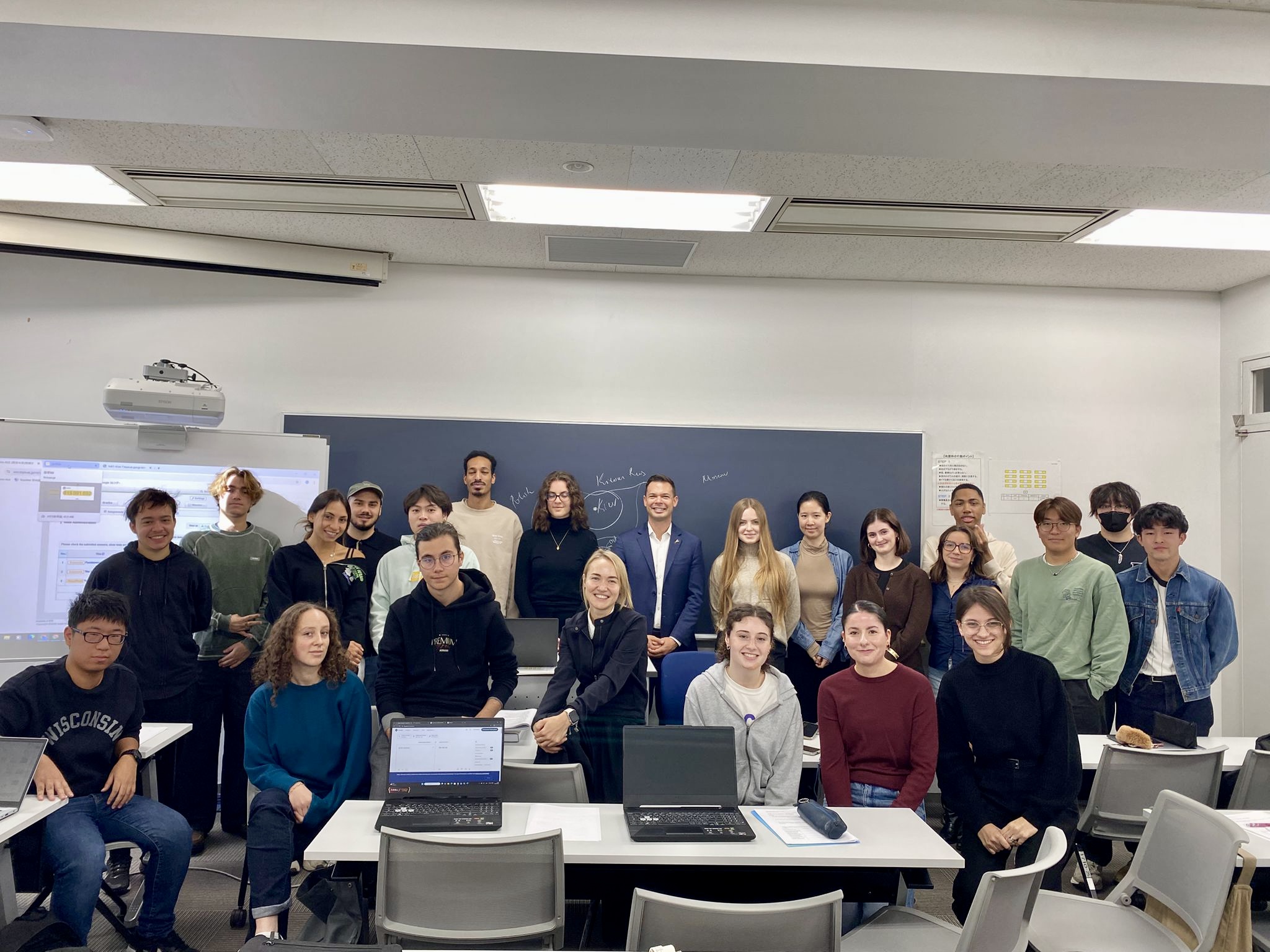
On 22 October 2025, I had the honour of delivering a special invited lecture at Toyo University in Tokyo, one of Japan’s leading law schools. The invitation came from Dr Zhou Yuan, Associate Professor of European Legal History and the History of Legal Thought at the Faculty and Graduate School of Law, and the lecture brought together undergraduate, master’s, and doctoral students, as well as faculty members interested in climate policy, energy security, and international law.
My lecture, titled “Net Zero is Peace? Beyond Apocalypse Crisis,” grew out of both my academic research and Ukraine’s lived experience of war, survival, and recovery. I set out to ask a simple but uncomfortable question:
can net zero be more than an environmental objective — can it become a tool for security and peace?
From energy systems to war — and back again
I spoke about how fossil fuels have never been a neutral resource. Historically, they have shaped empires, financed wars, and undermined democratic institutions. Russia’s war against Ukraine is one of the clearest contemporary examples of how energy dependence can be weaponised.
We discussed the contradictions of global climate policy: how governments publicly condemn aggression while continuing to finance it through fossil fuel purchases;
how massive subsidies for oil and gas undermine declared climate and security goals;
and why the net-zero transition is not a luxury of peacetime, but a necessity in times of crisis.
Drawing on Ukraine’s experience, I shared evidence of the climate and environmental damage caused by the war, alongside examples of extraordinary resilience: communities turning to decentralised renewable energy solutions while under constant attack.
Net zero as a peace strategy
One of the central messages of the lecture was that net zero is not only about emissions reduction. It is also about:
- reducing resource-driven conflicts,
- limiting dependence on authoritarian regimes,
- strengthening local and community resilience, and
- enabling fair and sustainable post-conflict reconstruction.
Ukraine today is, tragically, a testing ground for these ideas. Yet it also offers lessons for the world on how green recovery, legal reform, and the net-zero transition can help lay the foundations for long-term peace.
Why these conversations matter
The most valuable part of the visit was the discussion with students. Their questions were thoughtful and direct, about accountability for “war-related emissions,” the role of law in climate security, and whether a just transition is possible in an unequal world.
In their written reflections, many students shared that this was the first time they had understood net zero not as a technical target, but as an issue inseparable from war, democracy, justice, and security. For me, this confirmed the importance of connecting academic research with real-world experience.
For Ukraine, being present in international academic spaces matters deeply — not only as a country at war, but as a source of knowledge, legal innovation, and policy insight. Academic exchanges like this lecture are part of a broader science and knowledge diplomacy, helping to build long-term partnerships and shared approaches to global challenges.
I am sincerely grateful to my colleagues at Toyo University, to Dr Zhou Yuan, and to the students who engaged so openly in this conversation. Dialogue on net zero, security, and peace between Ukraine and the world is only beginning — and it is more necessary than ever.