Experts Discuss Environmental and Climate Dimensions of Ukraine’s Post-War Recovery
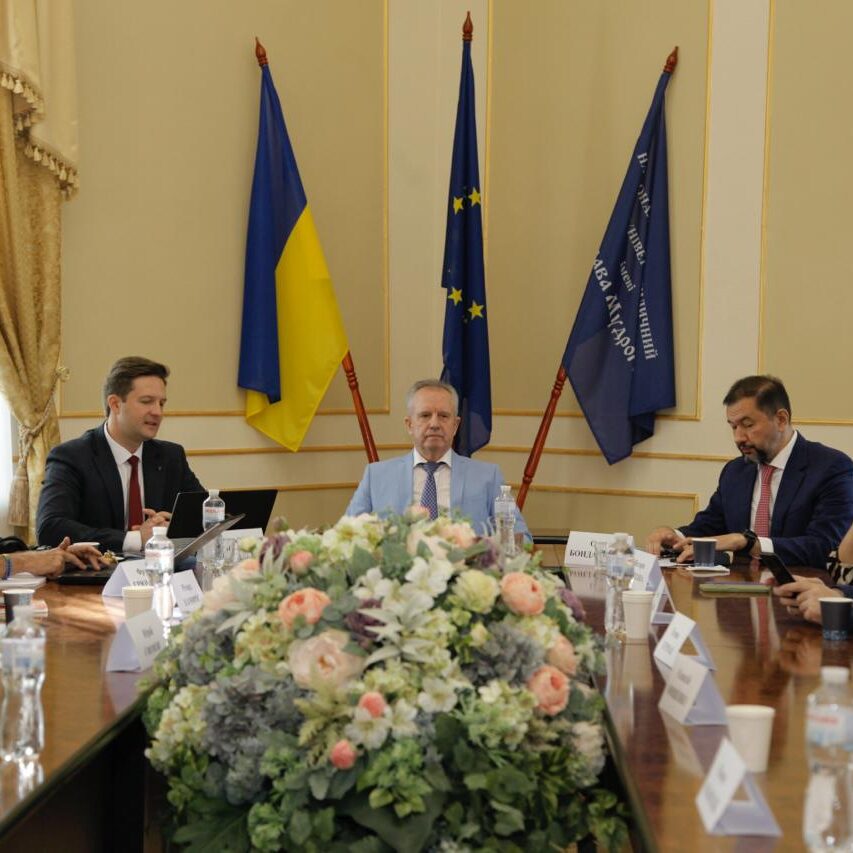
On 22 September 2025, the IX Kharkiv International Legal Forum opened with a high-level panel discussion, “Resilience, Security and the Rule of Law: Environmental and Climate Dimensions of Post-War Reconstruction,” . The discussion brought together Ukrainian and international experts in environmental and climate law, governance, science, security studies, and reconstruction planning to address one of Ukraine’s most urgent challenges: how to rebuild a country devastated by war while strengthening environmental protection, advancing EU integration, and upholding the rule of law.
The session was organised within the framework of the MSCA4Ukraine project “Towards Resilient and Resistant Climate Change Law (RESClimLaw)” implemented by the University of Genoa in cooperation with the Yaroslav Mudryi National Law University and its Sustainable Development and Environmental Law Centre.
Opening remarks highlighted the unprecedented scale of environmental damage caused by Russia’s full-scale invasion and the need to treat environmental security as a core component of national security. Anatoliy Hetman, Rector of Yaroslav Mudryi National Law University, emphasised that Ukraine’s reconstruction must proceed in parallel with climate policy and legal reforms required for EU integration. Oleh Bondarenko, Chair of the Verkhovna Rada Committee on Environmental Policy and Nature Management, reaffirmed Ukraine’s commitment to EU environmental and climate acquis, while warning against prolonged emergency derogations from environmental impact assessment (EIA) and strategic environmental assessment (SEA). Yuliia Ovchynnykova stressed that the scale of war-related ecological destruction makes environmental protection inseparable from state security and long-term recovery.
Civil-society perspectives were provided by Olena Kravchenko, Executive Director of the NGO Environment–People–Law, who warned of the erosion of environmental democracy and procedural safeguards during wartime and called for urgent horizontal reforms in monitoring, enforcement, and legal liability.
The discussion was moderated by Ievgeniia Kopytsia, MSCA4Ukraine Fellow at the University of Genoa and Associate Professor at Yaroslav Mudryi National Law University, and Yevgenii Suietnov, Head of the Department of Environmental Law at Yaroslav Mudryi National Law University. The moderators emphasised that recovery must go beyond rebuilding infrastructure and evolve into a transformative, climate-resilient, and EU-aligned agenda, noting that reconstruction decisions taken during the war will lock in environmental, economic, and governance outcomes for decades.
International expertise was contributed by Ian Monroe (Stanford University), Richard Humphreys (High Court of Ireland), Lennard de Klerk, Alex Cornell du Houx (University of San Francisco), Ganna Gladkykh (Stockholm Environment Institute), François Grünewald (Groupe URD), Anna Ackermann (International Institute for Sustainable Development), Borys Babin, and Sofiya Shutiak. Their contributions addressed accountability for war-related environmental and climate damage, green reconstruction, energy transition, and the role of courts and institutions in safeguarding environmental rights.
The outcomes of the panel have been consolidated in the newly published Synthesis Report, “Resilience, Security and the Rule of Law: Environmental and Climate Dimensions of Ukraine’s Post-War Recovery,” prepared within the RESClimLaw project.
The report translates expert dialogue into concrete findings and recommendations for policymakers, public authorities, civil society, and international partners, and is intended to inform legislative reforms, EU accession negotiations, and donor programming.
The discussion underscored that Ukraine’s post-war recovery is not only a technical or economic task, but a profound legal and institutional transformation in which environmental protection, climate governance, and the rule of law must serve as central pillars of a resilient, secure, and European future.
About RESClimLaw
RESClimLaw (Towards Resilient and Resistant Climate Change Law) uses Ukraine as a case study to examine how environmental protection, climate governance, and the rule of law can be designed to remain functional under extreme stress, including armed conflict, large-scale environmental degradation, climate shocks, and rapid socio-economic transformation. Ukraine’s post-war recovery is analysed as a real-time stress test for environmental and climate law, where reconstruction decisions taken under pressure shape long-term environmental, economic, and governance trajectories.
RESClimLaw develops legal and institutional insights relevant not only to conflict-affected settings, but also to countries facing compound crises such as climate extremes, energy transitions, natural disasters, economic disruption, or accelerated regulatory change. The project focuses on accountability for environmental and climate harm, the functioning of environmental democracy and impact assessment under emergency conditions, and the capacity of institutions and courts to operate under sustained pressure. By linking Ukraine’s experience to the EU environmental and climate acquis, RESClimLaw contributes to broader debates on climate resilience, environmental security, and rule-of-law governance in high-risk and high-uncertainty contexts globally.
No responses yet